
How to Create a Time Capsule in Your Home (And Why it Matters)
There was a moment, years ago, that has stayed with me.
It was 2005, and I was a secondary school teacher in Owen Sound. I was teaching a history unit on the 1920s and, at the same time, undergoing a bathroom renovation in our attic space. During the renovation, the contractor discovered a Maclean’s magazine tucked inside the floorboards of our home. It was dated February 15, 1929. What a coincidence, right?
I remember holding onto that story. Thinking about the person who left it there. Wondering if they ever imagined that someone, nearly a century later, would find it.
It wasn’t just a forgotten object.
It felt like a message.
And I think about that often now when I’m working in older homes.
Because the truth is, every home holds layers of stories. Some visible, such as a wall or trim with kids’ heights written on it. Others hidden, like the magazine I found. And still others waiting to be uncovered. When we step in to renovate, we’re not starting from scratch. We're continuing something. We are continuing the story of the house and its owners.
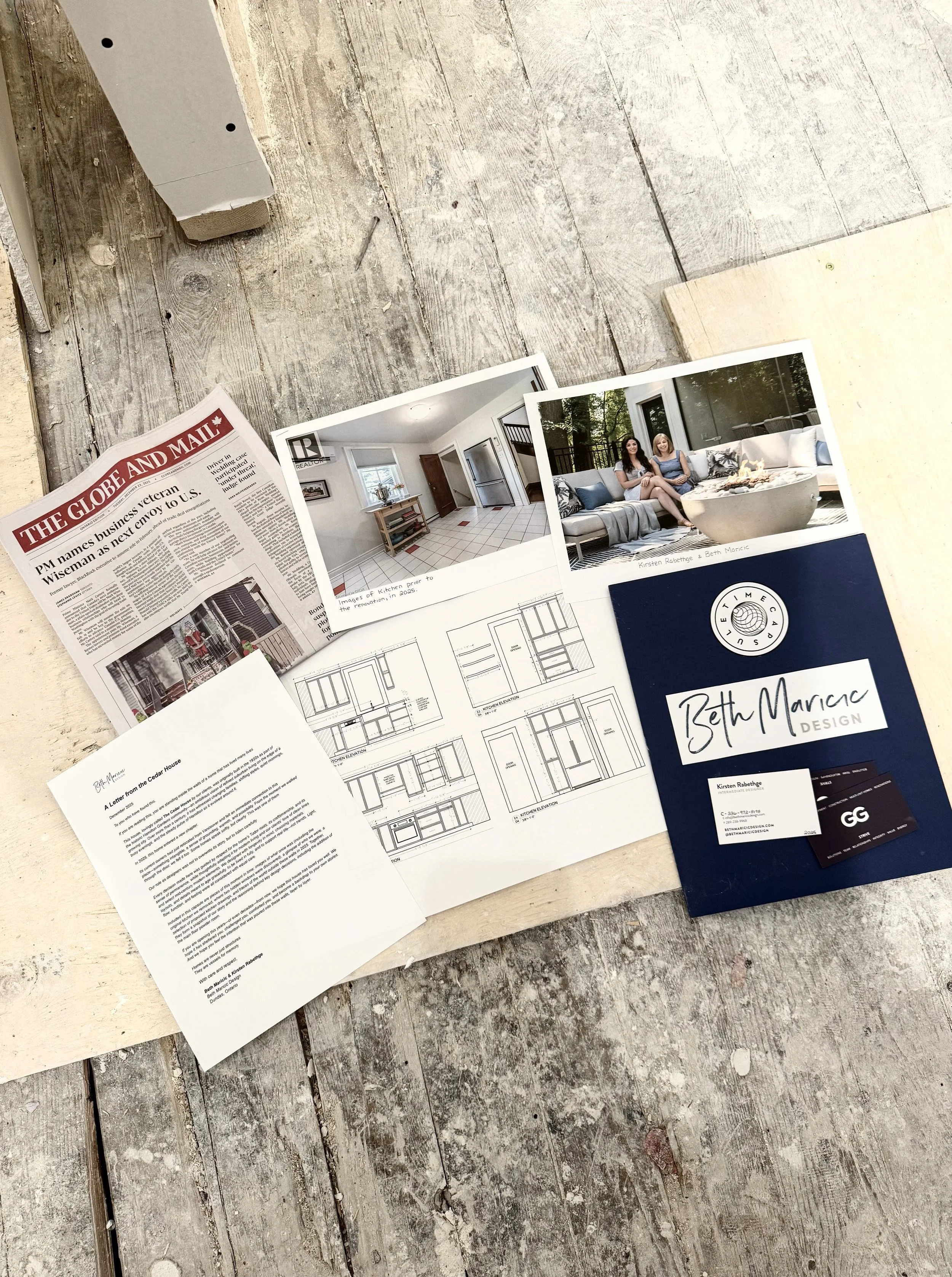
Cedar House: Time Capsule
That’s where the idea of the time capsule began.
Not as a trend.
Not as a feature.
But as a quiet gesture of respect.
A way of acknowledging what came before, while also leaving something behind for whoever comes next.
For me, a time capsule isn’t about perfection. It’s about honesty and about continuing the story.
It might include a letter that explains the home, the era it came from, and why certain design decisions were made. It might include fragments of the materials used, a few “before” photos, a small snapshot of life today, including a newspaper or a magazine, so that future inhabitants can see what influenced our lives and possibly our decisions.
It also includes a personalized note that says, we were here, and we cared for this place and respected its story.
The first official time capsule we created at Beth Maricic Design was placed in the walls of the Cedar House. A 1920s Tudor rooted in Hamilton’s history, now continuing its story with a new family who arrived here from Vancouver.
And as we worked through that home, studying its history, its materials, and its presence in the neighbourhood, it felt only natural to leave something behind that explains this and reflects our intentional incorporation of a new main floor powder room and a newly designed kitchen.
It was left not as a signature,
but rather as a continuation of the story.
Because good design isn’t just about how a space looks today.
It’s about how it lives over time.
How it’s understood.
How it’s remembered.
And maybe, hopefully one day, how it will be rediscovered.
If someone opens that wall years from now, I hope they pause for a moment to read through everything that was left by us.
In doing so, I hope they feel a sense of connection to this story.
And I hope they know…that this home and its roots were deeply considered throughout our continuation of its story.
In truth, every space holds a story.